
Robot Arm Link: Topology Optimization
The goal was a much lighter arm link for a pick-and-place robot without losing stiffness: topology optimization cut its mass by about 50% (about 103 kg per arm), with wrist deflection still about 20% inside the 0.35 mm target. FEA of the original link, then SIMP topology optimization, for a robot in an automated sheet-metal bending cell.
- Project
- Case study, Politecnico di Milano
- My role
- CAD, FEA, optimization and hand calculations
- Tools
- Abaqus / Abaqus Tosca Structure, SolidWorks
- Method
- SIMP topology optimization
- ≈50%mass reduction, ≈103 kg saved per arm
- 0.281mmwrist deflection of the reconstructed design, about 20% below the 0.35 mm target
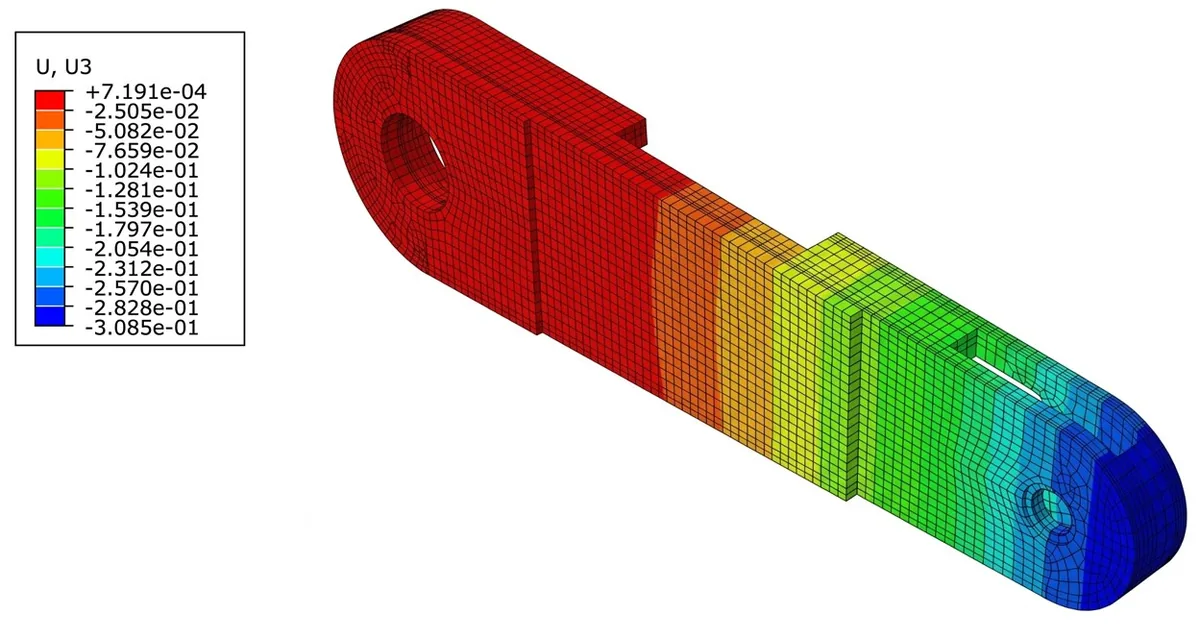
- 0.309mmbaseline maximum wrist deflection, 23% below the 0.4 mm limit
- ≈24safety factor from the hand calculation (20.6 MPa bending stress)
Skills shown
How I did it
A concept-stage design question for a stiffness-critical robot link: given the existing mounting envelope and its governing load case, how much material can be removed while still meeting the arm’s positioning-accuracy requirement?
-
Define the component and load case
SolidWorks
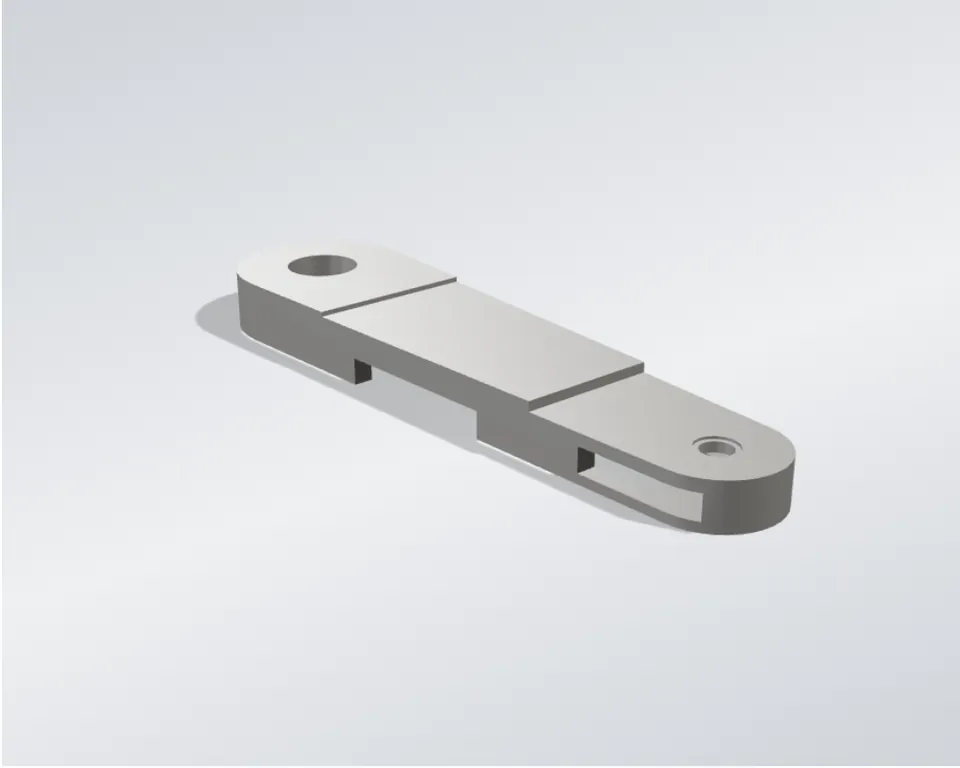
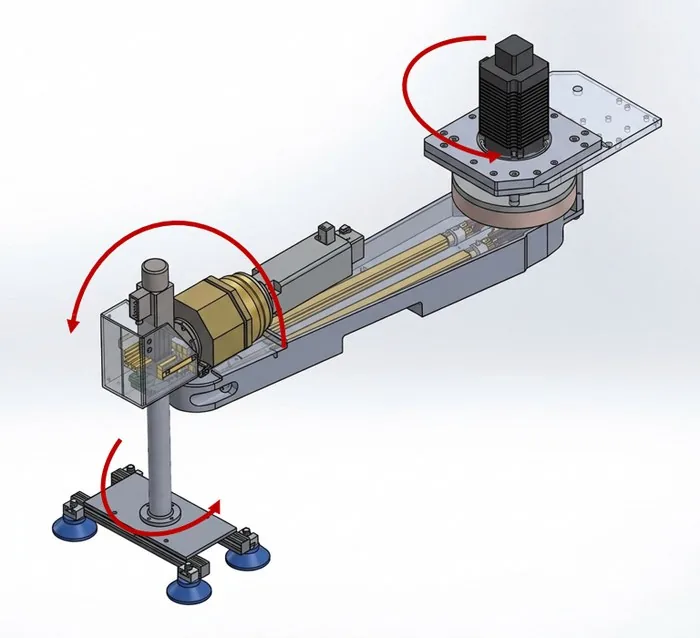
A structural link of a small pick-and-place manipulator on an automated sheet-metal bending press. It is the only load path between the manipulator’s base and wrist joints, so its stiffness governs the end effector’s positioning accuracy.
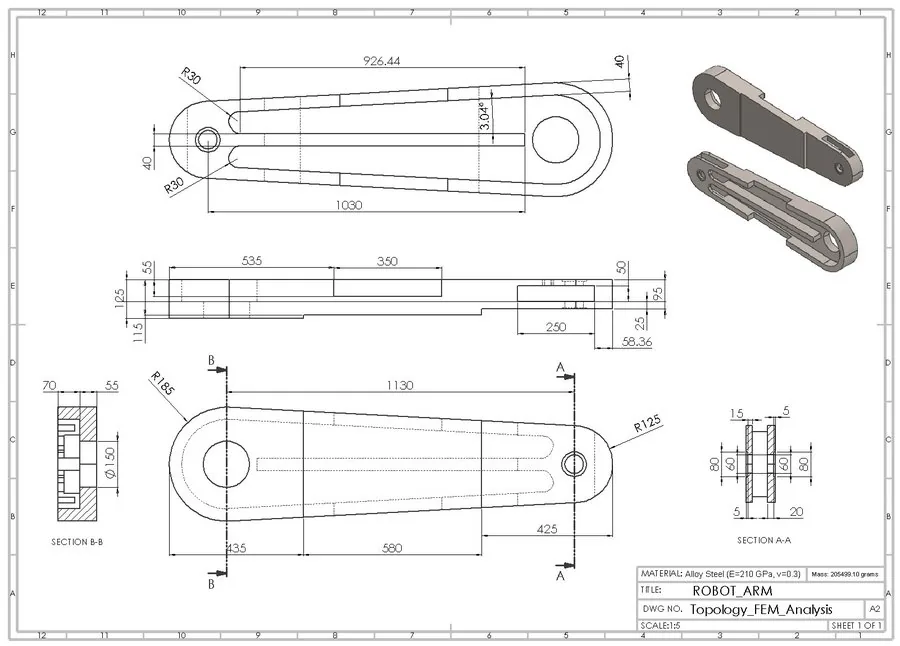
- Baseline mass
- 205.5 kg, Alloy Steel
- Span between bore centers
- 1130 mm
- Governing wrist load
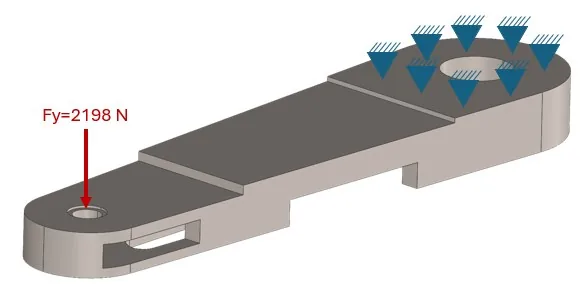
- 2198 N
- Wrist displacement
- ≤0.40 mm functional limit; 0.35 mm optimization target
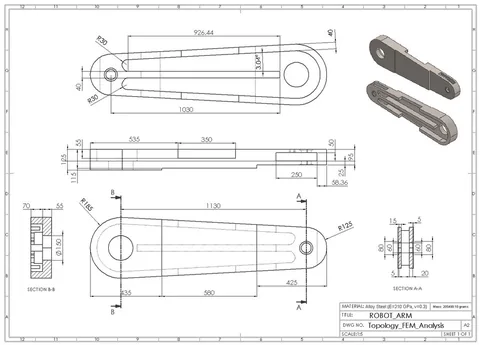
Reference engineering drawing (ROBOT_ARM, scale 1:5). Select to enlarge. 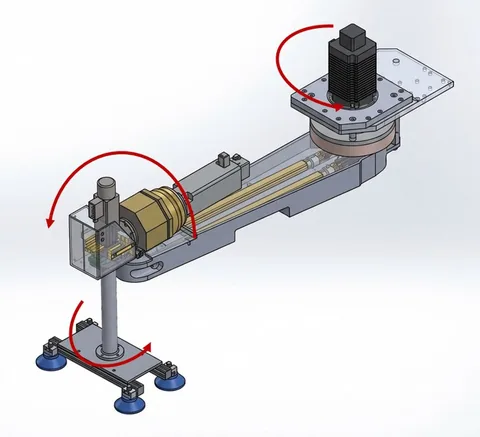
The link in context: one axis of the pick-and-place manipulator. 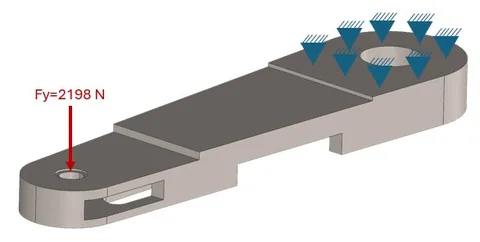
Governing load case: 2198 N at the wrist, base bore restrained. -
Set out the workflow
Abaqus/CAE, Abaqus Tosca Structure
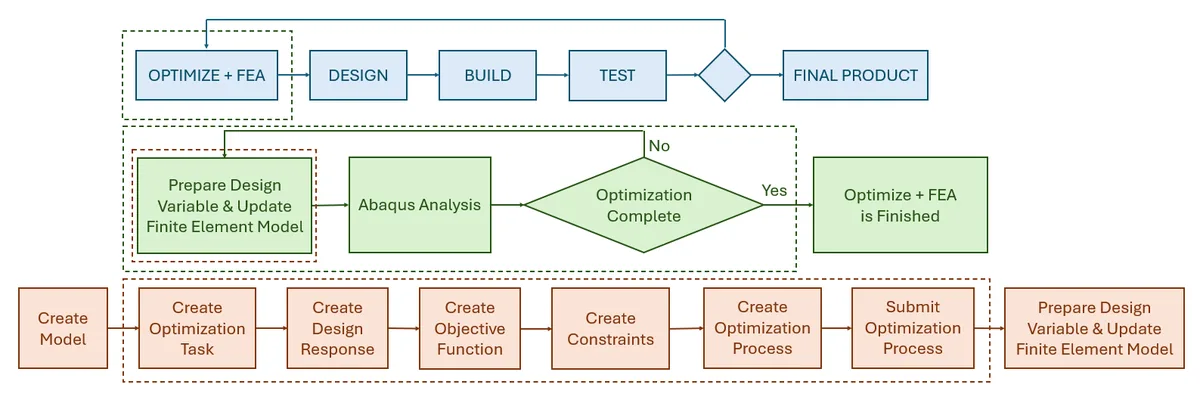
- Build and solve a baseline finite element model in Abaqus/CAE to establish a validated displacement result.
- Cross-check the baseline model against an independent hand calculation, rather than trusting the software alone.
- Run a SIMP topology optimization in Abaqus/Tosca Structure to quantify the achievable weight reduction.
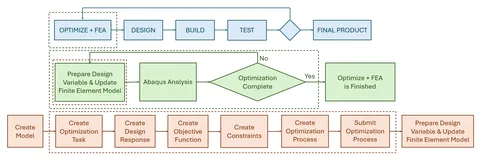
Structural optimization workflow used in this study: the design-build-test loop augmented with an Optimize + FEA step (top), the internal optimize/analyze loop (middle), and the Abaqus/Tosca Structure task sequence used to set it up (bottom). Select to enlarge. -
Build the baseline model
Abaqus/CAE
A hexahedral finite element model was built in Abaqus/CAE, solved, and checked against an independent hand calculation before any weight was removed.
- First-order reduced-integration hex elements (C3D8R) with a 14 mm seed, chosen because first-order tetrahedra are overly stiff in bending-dominated parts.
- Base bore fully encastred; the 2198 N wrist load applied as an equivalent bore pressure (1 MPa) rather than a point load.
- Mesh-quality check: no elements flagged as errors, only minor warnings at the boss fillets, away from the verification section.
- Elements
- C3D8R hex, 14 mm seed
- Wrist load
- 2198 N as 1 MPa bore pressure
- Max. wrist deflection
- 0.309 mm
- Hand-calc bending stress
- ≈20.6 MPa (FS ≈24)
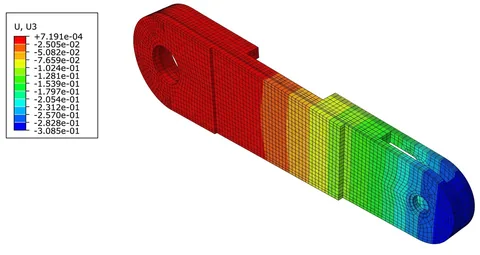
Baseline vertical displacement (U3). Maximum −0.309 mm at the loaded wrist bore. Select to enlarge. -
Run the topology optimization
Abaqus Tosca Structure
With the baseline shown to be stiffness-governed and comfortably inside its displacement limit, the arm is a strong candidate for an aggressive, stiffness-constrained weight reduction.
- Objective: minimize strain energy under the 2198 N wrist load (maximize stiffness).
- Constraints: volume ≤50% of the design domain; wrist displacement ≤0.35 mm.
- Manufacturing: demold control, single pull direction along the global Z axis; both bores frozen from the design domain.
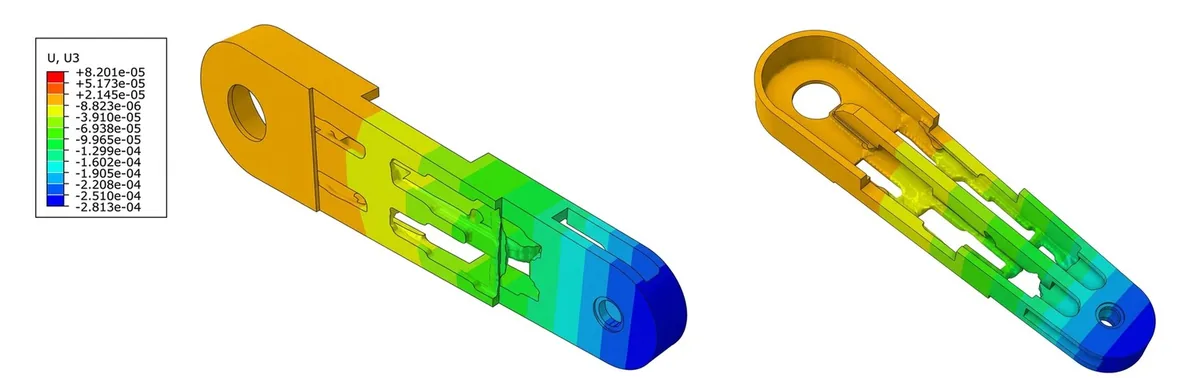
The optimizer keeps a shell around both frozen bores and connects them with two diagonal ribs. This is the textbook topology-optimization solution for a short, deep cantilever, and evidence the task was set up correctly. This is consistent with published 40–50% mass reductions on comparable robot-arm links.
- Mass reduction
- ≈50%, ≈103 kg per arm
- Design cycles
- 20
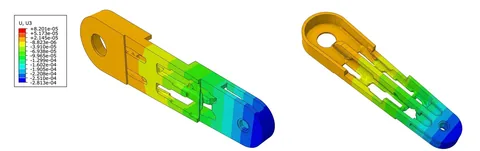
Reconstructed, remeshed geometry after topology optimization, re-analyzed under the baseline load case. Maximum displacement 0.281 mm at the wrist. 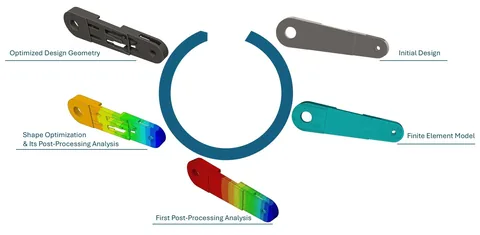
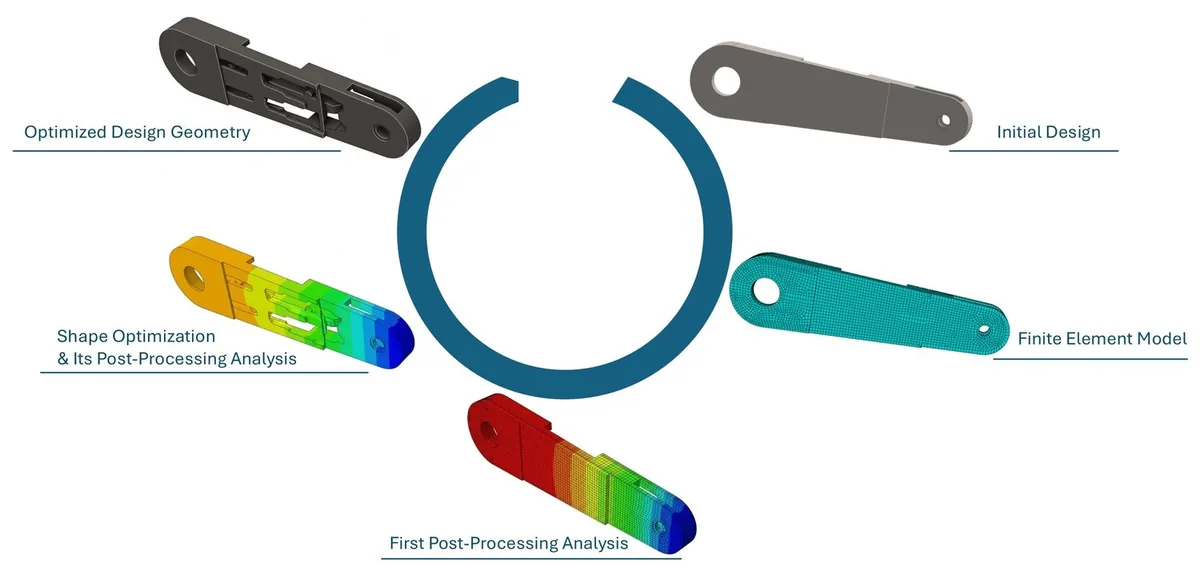
The complete design cycle: initial design, finite element model, and baseline analysis, feeding the shape optimization and its post-processing analysis that produced the final optimized design geometry. Select to enlarge.
How I checked the results
The baseline was checked against an independent hand calculation before any weight was removed, and the optimized topology was rebuilt and re-analyzed rather than taken from the optimizer.
0.309mm
maximum wrist deflection, 23% below the 0.4 mm limit
An independent Euler–Bernoulli hand calculation gives a mid-span bending stress of about 20.6 MPa (safety factor ≈24). Both checks agree: the arm is governed by stiffness, not strength, exactly the condition a stiffness-constrained topology optimization can exploit.
0.281mm
reconstructed design, re-analyzed under the baseline load case
The topology was reconstructed as a solid, remeshed (triangulated surface converted to a tetrahedral mesh in Abaqus’s Edit Mesh toolset), and re-analyzed under the baseline load case: the reconstructed design deflects 0.281 mm, about 20% below the 0.35 mm optimization target and 30% below the 0.4 mm functional limit, confirming the result independently of the optimizer’s internal, density-penalized estimate. If that tetrahedral mesh is first-order, it reads slightly stiff in bending; a confirmation run with quadratic tetrahedra (C3D10) and a mesh-convergence check would close that gap before release.
Optimization convergence history
20 design cycles. Hover a point for the value at that cycle.
Objective and displacement converge within about seven to nine cycles; volume overshoots the 50% target around cycle five to six, then settles toward it by cycle twenty. This is the normal signature of Tosca Structure’s internal bisection search on the volume constraint.
Engineering judgment and recommendations
What the study found beyond the headline number, and what’s still open before release.
-
Reconstructed geometry, remeshed and re-verified
The topology-optimized shape was rebuilt as solid CAD, remeshed (triangulated surface converted to tetrahedra in Abaqus’s Edit Mesh toolset) and re-analyzed under the baseline load case, confirming a 0.281 mm maximum displacement, about 20% below the 0.35 mm target, independently of the optimizer’s internal, density-penalized estimate.
-
Flagged
Fatigue is still open
Static margin is large (FS ≈24), but duty is cyclic. Stress at the bores and new rib roots hasn’t been checked and should clear before a fatigue release.
-
Topology, not material, was the right lever
Steel’s specific stiffness (E/ρ) is within a few percent of common aluminum alloys, and the mounting envelope is fixed, so swapping material alone would not have made the arm lighter at the same stiffness. Redistributing the material was the correct move.
-
Demold constraint keeps it manufacturable
A single pull-direction constraint keeps the topology extractable from a mold along the global Z axis. The rib-to-shell transitions still need a shape-optimization pass before release.